Showing posts with label Review. Show all posts

Saturday, May 26, 2012

Mac OS X Lion hands-on preview


The apple company declared Mac OS X Lion with significant excitement at its Returning to the Mac occurrence last Oct, and now it's decreased the first designer review on the community -- providing us a opportunity to taste some of the big pet's new functions and UI principles. We set up the dev develop on one of our MacBook Professionals and used it over the few days, and while we won't be able to see any large changes in day-to-day work-flows until our preferred applications are modified to take benefits of Lion, we did see a lot of exciting system-level functions and extras -- and yes, iOS's effect is all over the position. Study on for a complete malfunction of what's new!


Launchpad


Apple's making a big cope out of Launchpad, Lion's new iOS-style app launcher, but we're supposing most energy customers will adhere to the Person, Connect, and Concentrate for immediate entry to frequently-used applications. We're wondering less-advanced customers will really like it, though -- it imitates the effective iOS app user interface to a tee, such as directory assistance and immediate app sets up from the Mac App Shop.

Full-screen apps

Another function that seems meant to be ignored by energy customers and dearest by the public, Apple's forcing difficult for designers to develop full-screen app opinions for Lion. It's an concept to suit some applications much better than others -- iPhoto and Opera work well in full-screen function, but starting iCal fullscreen on our 27-inch iMac was efficiently absurd. Changing an app to complete display reveals it in a devoted area by standard, so you can easily change between the pc and start full-screen applications with a three-finger run -- a shift that imitates the multi-tasking actions Apple's been examining in iPad iOS designer creates.

Mission Control

While Launchpad and the concentrate on full-screen applications experience targeted at the informal individual, Objective Control seems like the actual reverse -- a function only a energy individual could really like. It's generally a specific management UI for Present and Areas that comes up with a three-finger run up, and while it performs well for what it is, it doesn't really decrease any complexness -- it just creates it all simpler to see at once. That's useful enough, we assume, but the Connect, command-tab app switching, and the multi-tasking actions all experience more effective than losing into Objective Control thus far.


AirDrop

One of Lion's niftiest new functions is AirDrop, which allows fast and simple computer file transactions between WiFi-equipped Apples. Starting the AirDrop section in the Person creates your device discoverable to other devices with AirDrop start, and changing information is as simple as pulling and verifying. Although it uses WiFi, you don't need a wireless router to use it -- the WiFi snacks in most modern Apples are able to quickly change back and forth between AirDrop and a conventional program relationship. The apple company hasn't said what the earliest device with AirDrop assistance is, but we get the sensation even devices that are several decades of age will be able to use the function.

Resume

Another collection from iOS, applications are now able to preserve condition on quit and choose up right where they remaining off. This connections in with the new multi-tasking control -- even if the program leaves an app to totally restore sources, continue indicates it'll look like nothing ever occurred when you start it again. Obviously this technique has been used to great impact in iOS and Operating program (and gradually in Ms windows Cellphone 7), but we'll see how it performs out on the pc, where applications use greatly more storage space and storage space.

App updates

Apple's remodeled a variety of of built-in applications in Lion, and the iOS impact is easily obvious -- run some of these applications full-screen on an 11-inch MacBook Air and you'd be hard-pressed to tell the change from an iPad. Some highlights:


Multitasking and app management


One significant modify Apple's created in Lion is that operating applications will denoted by a little "light" in the Connect. Just like iOS, Lion is developed to handle sources for the individual, in an attempt to create multi-tasking absolutely sleek. That indicates the program can "freeze" applications in the qualifications, destroy procedures, and otherwise do whatever it requires to retain the buyer. It's a awesome concept, and we're sure some individuals will really like it, but we'd rather take fortune into our own arms when it comes to handling applications -- so it's a advantage you can always see what applications are operating by reaching control-tab or by switching the lighting returning on in choices.

Gestures

Lion presents a variety of new multi touch program actions that create using the OS with a track pad much more organic and sleek. We're not sure how these actions will map to a Miracle Rabbit (which really only performs for single- and two-finger gestures) or a conventional mouse, but if there was any purpose for pc customers to get a Miracle Trackpad, Lion is it. Some highlights:


Swipes and scrolling


Three-finger swipes are everywhere in Lion -- a run to the remaining to change between Areas and full-screen applications, a run down to demonstrate app ms windows, a run up to demonstrate Objective Management, a run right to demonstrate the Dash space. You can also touch in with four-fingers (really, three hands and your thumb) to bring up Launchpad, and touch out to demonstrate the pc. All of these can be personalized, of course, but it's definitely significant that Apple's allowing multi touch track pad actions as a standard navigational device.

Two-finger actions have been a little bit modified as well -- horizontally swipes now control returning / ahead in Opera by standard, and scrolling is now ugly by standard, as in iOS. (You can change it returning to frequent, fortunately.) There's also a new personal preference that generally eliminates the system of search cafes if you're using a track pad, instead displaying an iOS style disappearing search sign.

Pinch to zoom

Pinch-to-zoom in Opera is now just like Cellular Opera in iOS -- it easily zooms the whole web page, instead of just booming styles at set amounts. It's exciting, but it seems a bit half-finished -- we found some stuttering and relics here and there. We're supposing The apple company will fresh this up before launch.


Versions and Auto Save


You might think of Editions and Auto Preserve as Time Device for applications -- Lion applications instantly save changes to records as you work, and then you can look through between stored versions using a difference of the Time Device program. It's great products that proved helpful really well when we examined it in TextEdit, although we'll see how well it functions with high quality press information.


Wednesday, May 16, 2012

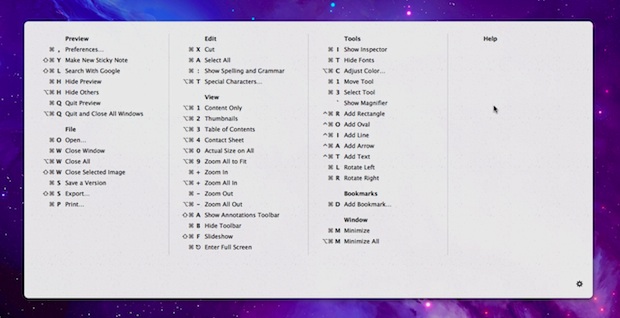
Instantly See All Keyboard Shortcuts for Mac Apps with CheatSheet


There are so many key pad strategies throughout Mac OS X and it’s variety of third celebration programs that it’s simple to ignore them or get missing trying to remember the sea of key strokes for each app. This is where CheatSheet will create simpler, it’s a small no cost program that rests in the qualifications holding out around to be called from any app to immediately display all key pad strategies for that program.

Get CheatSheet for totally exempt from Press Atelier (requires OS X 10.7 or later)
After you have downloadable CheatSheet, position it in /Applications/ directory and the release the app. Now from any program, carry down the Control key for a short time to call the “Cheat Sheet” record of all key pad strategies for that app. This allows you to easily see even the most unknown strategies that would otherwise be hidden deeply within a submenu somewhere.


Fast trouble shooting tips: if some applications are not addressing the hotkey, either relaunch those applications or try launching and having Management again and it should stimulate. Also if you have overlooked the significance of Mac key pad signs it may be enjoyable to evaluation those really quickly.

My only issue about CheatSheet is that since it operates in the qualifications you have to use something like Action Observe to quickly stop out of it. Having an optionally available food selection to call the deceive piece for the dynamic program, provide you with some power over primary configurations like reaction time, and having a fast way to stop CheatSheet would be a awesome contact, but this is a free app that is very useful as is so we really cannot grumble too much.

Whether you are a while Mac individual or absolutely new to the foundation, you are essentially assured to find CheatSheet useful. Get it now and thank me later.

Saturday, May 14, 2011

Apple OS X Lion (10.7) review


Never one to shy away from extraordinary hyperbole, Bob Tasks announced ours a "post-PC world" about now last season, recognizing a shift away from pcs as smartphones on the market and pills become even more popular. And while Tasks might gladly look on as iPhones and iPads become our mainly tie to the outside community, the concern remains: what happens to the PC during this huge transition? To a huge level, the response can be found in the OS, which delivers us to OS X Lion. Women and guys, welcome to post-PC processing.

In generally special style, the organization has announced OS X 10.7 "the globe's most innovative pc os," offering the inclusion of over 250 new functions. The record is very irregular on the game-changing range, with up-dates operating the range from Airdrop (file-sharing over WiFi) to a full-screen edition of the included mentally stimulating games activity. If there's one factor attaching it all together, though, it's something that Tasks moved on when he first revealed the OS returning in October: the unique effect of iOS. Now it's real, we already got a flavor of that with gesture-based trackpads and the Mac App Shop, but those were merely glimpses of elements to come. Apple organization gets so intensely from iOS that at periods, bicycling through functions creates the whole factor experience like you're merely managing an iPad with a key pad connected.

There are a lot of welcome extras here, such as visual modifications and interest to increasing comfort issues. Like Snowfall Leopard before it, however, Lion is hardly an intense update. And like Snowfall Leopard, it comes in at a affordable $29 (or a extremely more expensive $69 as an future memory stick install), creating it a deserving update for present Mac entrepreneurs. But does a ton of transformative functions add up to a innovative upgrade? Let's discover out.

Saturday, April 30, 2011

Mac OS X 10.7 Lion: the Ars Technica review


Mac OS X 10.7 was first proven to the group in Oct 2010. The display was moderate, especially as opposed to strong over stated claims that associated the releases of the iPhone ("Apple reinvents the phone") and the iPad ("a wonderful and innovative program at an incredible price"). Instead, Bob Tasks simply known as the new os "a look at where we're going with Mac OS X."

Behind Tasks, the display detailed the seven past significant produces of Mac OS X: Cheetah, The puma corporation, Jaguar, Panther, Competition, Leopard, and Snowfall Leopard. Such brief retrospectives are de rigueur at significant Mac OS X reports, but long-time The apple company viewers might have sensed a minor hurt now. The group "big cat" promotion for Mac OS X only started with Jaguar; value brands for the two previously editions were not well known outside the designer group and were certainly not aspect of Apple's formal promotion concept for those produces. Why carry the cat concept back to the leading edge now?


The response came on the next fall. The next significant launch of Mac OS X would be known as Lion. Tasks didn't create a big cope out of it; Lion's just another big cat name, right? Within a few moments, we were on to the next fall, where Tasks was throwing the new release's message: not "king of the jungle" or "the greatest big cat," but the "back to the Mac" concept actual the whole occurrence. Mac OS X had created iOS, and now The apple company was providing enhancements from its cellular os returning to Mac OS X.

Apple had justification to shy away from introducing Lion as the epitome that its name indicates. The last two significant produces of Mac OS X were both significantly formed by the meteoric increase of their youthful brother, iOS.


Leopard came later than predicted, and in the same season that the iPhone was presented. Its heir, Snowfall Leopard, popularly came with no new functions, focusing instead on inner improvements and bug repairs. Despite possible formal details, it was difficult to move the sensation that Apple's growing cellular foundation was getting resources—not to bring up the spotlight—from the Mac.

In this perspective, the name Lion begins to take on deeper descriptions. At the very least, it seems like the end of the big cat branding—after all, where can you go after Lion? Is this procedure of getting the best from iOS and providing it returning to the Mac foundation just the first stage of a finish assimilation? Is Lion the end of the range for Mac OS X itself?


Let's put aside the gloomy prognostication for now and consider Lion as a item, not a portent. The apple company pegs Lion at 250+ new functions, which doesn't quite go with the 300 recognized for Leopard, but I think it all is determined by what you consider a "feature" (and what that "+" is predicted to mean). Still, this is the most considerable launch of Mac OS X in many years—perhaps the most considerable launch ever. Though the variety of new APIs presented in Lion may are unsuccessful of the milestone Competition and Leopard produces, the most essential changes in Lion are extreme accelerations of previous styles. The apple company seems to be sick and exhausted with pulling individuals throwing and shouting into the future; with Lion, it has basically determined to keep without us.